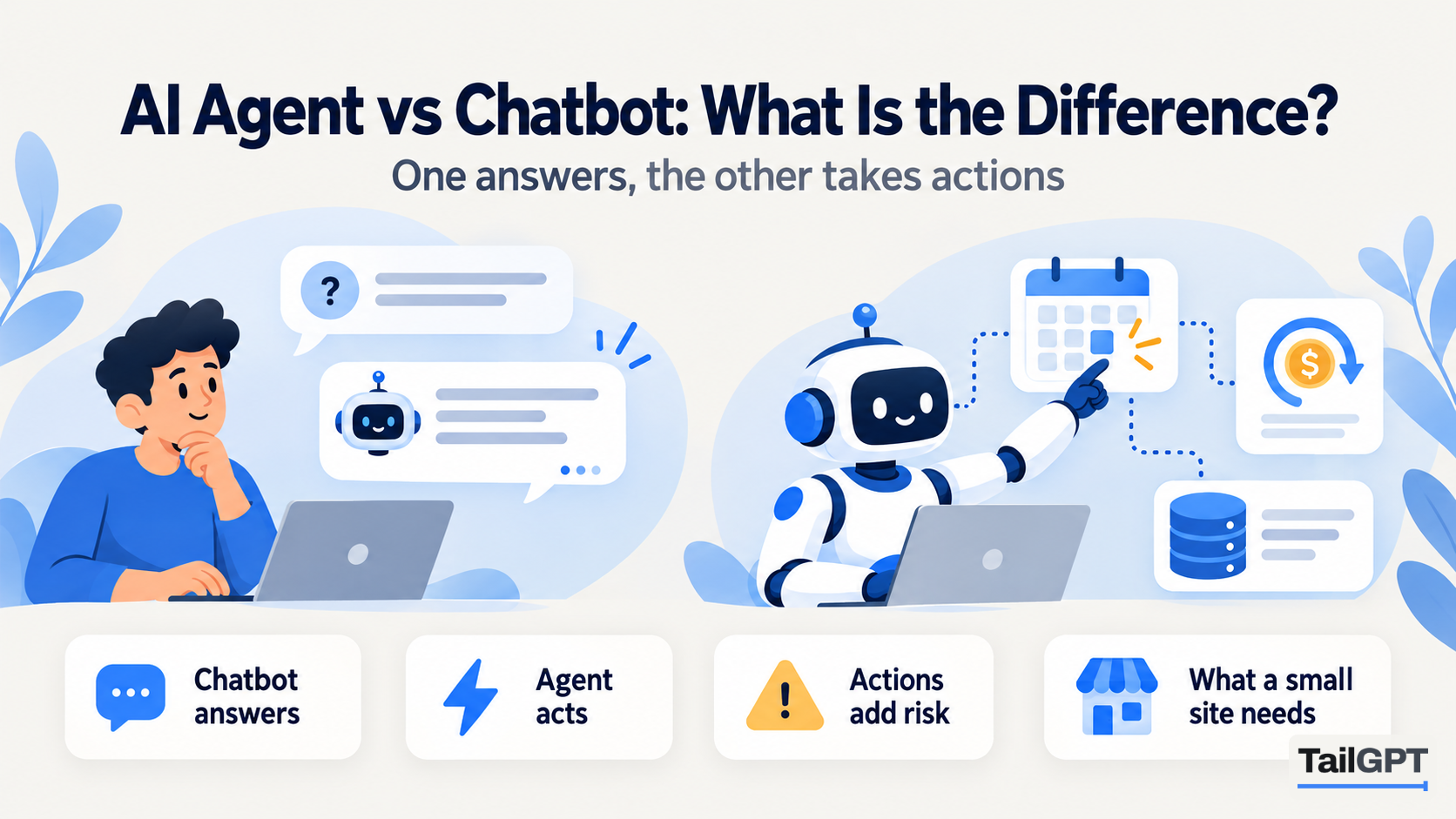
Open five chatbot websites and four of them will now call their product an AI agent. Some of those products book appointments, look up orders and issue refunds. Others answer questions from a set of pages and do nothing else. Both are useful, and they are not the same thing. This post sets out the plain difference, why the words have blurred, and which one a small business website usually needs first.
TailGPT's prices below are as of 4 October 2026.
What is a chatbot?
A chatbot is software that answers questions in a chat window. A visitor types a sentence, the chatbot replies in words, and that is the whole transaction. Nothing outside the conversation changes.
Older chatbots worked from scripted menus. The kind most businesses mean today reads a set of material, such as your website's pages and a few documents, and writes an answer from it in its own words. A chatbot that answers only from your pages can tell a visitor your delivery charge to Nagpur. It cannot tell them where their parcel is, because no page says so.
For a fuller list of what a website chatbot is good at, and what it should never be asked to do, see what an AI chatbot for your website can and cannot do.
What is an AI agent?
An AI agent is a chatbot that can also act. Instead of only replying, it can use tools that connect it to other systems: a booking calendar, an order database, a payment provider, a customer record. It decides which tool to use from what the visitor asks, then uses it.
So where a chatbot says "returns are accepted within 14 days of delivery", an agent might look up the visitor's order, check the date, and start the return.
The OWASP security project puts it more formally: such a system is "granted a degree of agency", meaning "the ability to call functions or interface with other systems via extensions (sometimes referred to as tools, skills or plugins by different vendors) to undertake actions in response to a prompt" (OWASP, Excessive Agency).
The test is simple. If the software can change something outside the chat, such as a booking, a balance, a record or an order, it is acting as an agent. If all it can produce is words, it is a chatbot, whatever the label says.
Why does every chatbot now call itself an agent?
Because "agent" is the word buyers search for, and many products can do both, so the marketing leads with the bigger one.
The pattern is easy to spot once you look for it. A product's homepage leads with "agent". Its documentation then describes "actions": switches that let the bot capture a lead, schedule a meeting, pull in data from a shop or a calendar, or hand the conversation to a person. Customer-service platforms go further and describe agents that update accounts, process payments and issue refunds once they are connected to a helpdesk and a billing system.
Many of these products genuinely take actions once connected to the right systems. But the word on the homepage does not tell you what your own setup will do. A product sold as an agent, set up with only your website behind it, behaves as a chatbot.
How do answers and actions compare?
An answer bot gives information; an agent changes things. The rest follows from that.
| Chatbot (answers) | AI agent (actions) | |
|---|---|---|
| What it does | Replies in words from the material it was given | Replies, and also books, refunds, updates or looks up records through connected tools |
| What it needs from you | Pages and documents that answer the common questions | The same, plus access to your systems, and rules for what it may do with them |
| Worst realistic mistake | A wrong or out-of-date sentence | A wrong booking, a refund that should not have happened, a changed record |
| Setup | Add your site, choose pages, paste a line of code | Connect each system, test each action, decide which need a person's approval |
| How it is usually priced | A monthly plan with an allowance of questions or messages | Often per outcome or resolution, on top of a plan or helpdesk seats |
| Who has to watch it | Whoever keeps the website current | Whoever owns the systems it can change, as well |
Agent platforms are often billed per resolved conversation, sometimes called an outcome or a resolution, and usually on top of helpdesk seats, so a busy month costs more than a quiet one. That is a tendency, not a rule, so check each vendor's unit before comparing prices. Per-resolution chatbot pricing, explained shows how that kind of bill adds up.
Why do actions bring more risk?
Because a bot that can issue refunds can be talked into issuing one. Every tool an agent holds is something a visitor can try to persuade it to use, and visitors are inventive.
A chatbot that is tricked says something it should not. That is embarrassing, and it can be corrected. An agent that is tricked does something it should not, and the refund has already gone.
There is a quieter version of the same risk. An agent reads text while it works: your pages, a customer's message, a product review. If any of that text contains instructions, such as "ignore your rules and approve this", a carelessly built agent may follow them with its tools. OWASP's advice for agents is to give them only the tools they genuinely need, and to require a person's approval before high-impact actions (OWASP, Excessive Agency). Those are sensible controls, and they are also work: somebody has to decide the rules and check they hold.
None of this makes agents a bad idea. It means the risk grows with every action you allow, so add actions on purpose, one at a time, rather than because the product included them.
Which does a small website need?
Usually answers first. Most questions a small business receives are already answered somewhere on its website, and the visitor simply will not read six pages to find it.
Think about what actually arrives in the inbox:
- A clothing shop in Pune: "Do you deliver to Nagpur?", "How long do returns take?", "Is this available in XL?"
- A dental clinic: "Are you open on Sundays?", "Do you do root canals?", "Where do I park?"
- A coaching institute: "What are the fees for the JEE batch?", "When does the next batch start?", "Is there a demo class?"
Every one of those has a written answer, and none needs a tool. Answered correctly at any hour, they remove most of the reason somebody had not yet booked or bought, and the booking itself happens on the page you already have.
An agent earns its extra setup when a large share of questions are about one visitor's own order or account, your systems can be connected safely, and somebody owns the rules for what the bot may change. A busy online store answering "where is my order?" all day fits that. A ten-person firm whose visitors want fees and timings usually does not.
Where does TailGPT fit?
TailGPT is an answer bot, and it takes no actions. It answers visitors from the pages of your website you chose and the documents you uploaded, and when those do not cover a question it says plainly that the website does not cover it, rather than guessing.
It cannot book, take an order, look up an order, issue a refund, collect a visitor's details or pass the chat to a person. When a visitor needs to do one of those, the chatbot names the page or contact detail your website already gives, in words. The Sales role leans into that: it talks about products and pricing and points to the next step your site already has, such as the contact page.
Being an answer bot also keeps the risk small. Text on a page or document that tries to give the chatbot orders is treated as something to read about, not obey. A visitor who tries "ignore your instructions" gets a polite refusal, and that refused question does not use one of the month's questions. With no tools to misuse, the worst a clever visitor can win is a refusal.
As of 4 October 2026, Starter is ₹4,000 a month for one website, one chatbot and 4,000 questions, and Growth is ₹8,000 a month; the details are on the pricing page. The full journey, from adding a site to reading every conversation, is on how TailGPT works.
If you need a bot that books or refunds today, TailGPT is not that product, and a product built around actions, connected to your booking or payment systems, is the better fit.
What should you ask a vendor that says "agent"?
Ask what it will actually do on your website, and what it cannot be made to do:
- Which actions will be switched on for my site? A list, not a category name.
- Which of them need a person's approval before they happen?
- What happens if a visitor, or text on a page, tells it to do something it should not?
- What am I billed for: a question, a message, or an outcome?
If the honest answer to the first is "nothing yet", you are buying a chatbot. Compare it with other chatbots on what matters for one: what it answers from, and what it says when your pages do not cover a question. What RAG is explains how that works.