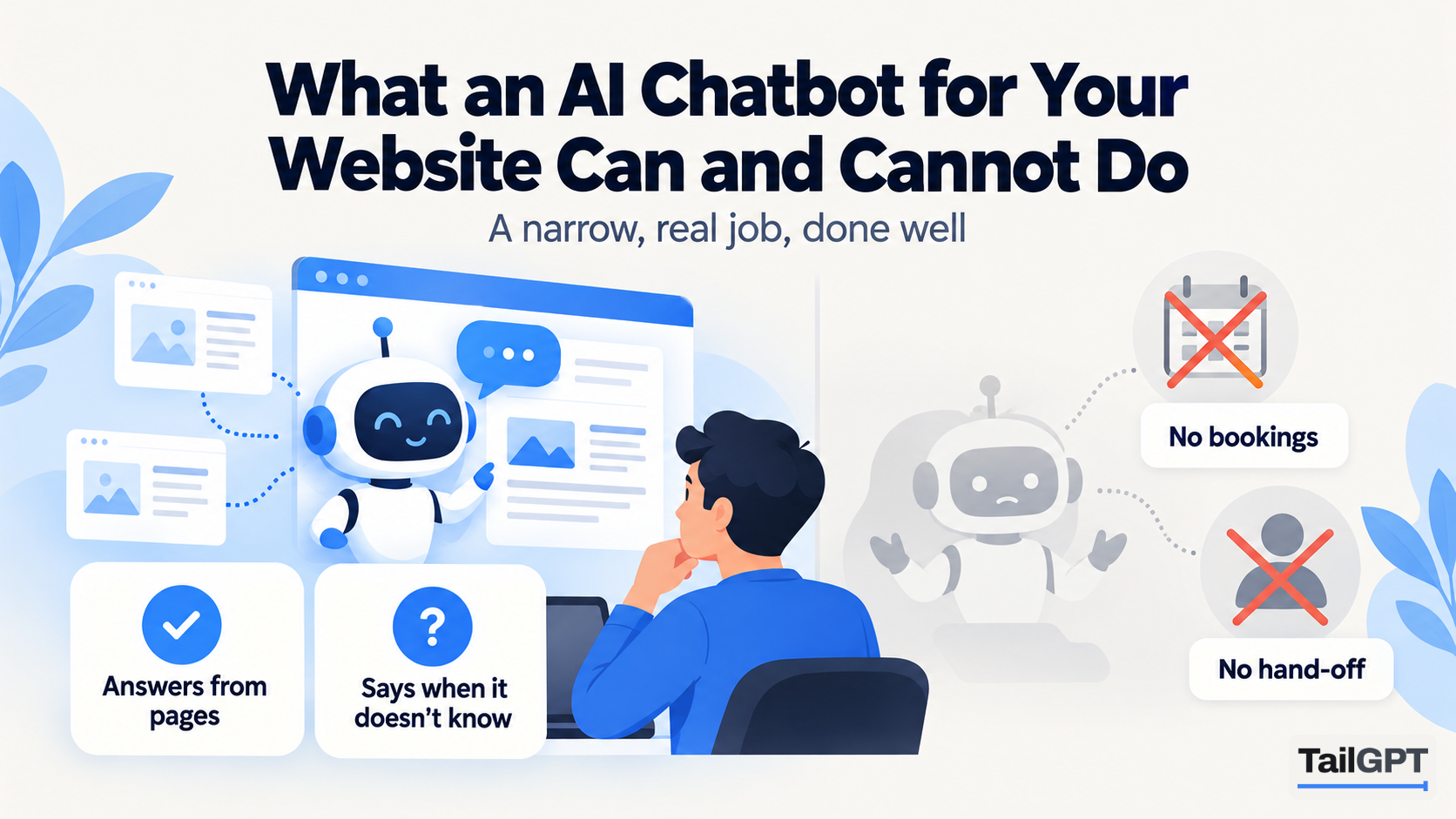
An AI chatbot on your website reads the pages you choose and answers visitors from them. It is useful for a narrow, real job, and it is not a member of staff.
What it does well
Most of what a support inbox handles is already written down somewhere on the site: delivery, returns, sizes, opening hours, what you sell and what you do not. A visitor will not read six pages to find it. They will type one sentence, and the chatbot answers from those pages in a second, with a link to the page it used.
The second thing it does well is quieter and worth more. It tells you what your website is missing. Every question it could not answer is a gap, and the list of gaps is a content plan written by your customers.
It also works outside your hours, which is when a surprising share of questions arrive. Nobody staffs a chat window at two in the morning, and the questions that come in then are almost always ones your website already answers.
What it does not do
- It does not act. No orders, no refunds, no changing an address in your system. It answers and hands off.
- It does not know what is not written. If a policy lives in somebody's head or a WhatsApp thread, it is not an answer.
- It does not negotiate. A visitor who tries to talk it into a discount gets the same treatment as any uncovered question.
- It does not replace a person. It clears the repeats so a person has time for the things that need judgement.
What it needs from you
Less than you would think, but not nothing.
- Choose the right pages. Policy and product pages answer most questions; old campaigns and press releases answer none.
- Keep them current. A chatbot knows your website as it was when it last read it.
- Read the misses. Ten minutes a month turns the list of unanswered questions into the pages you should write next.
Where people get it wrong
Two mistakes are common. The first is pointing it at the whole website - every blog archive, every old campaign - on the theory that more is better. More is slower and no more accurate; a page from three years ago is a promise you stopped making.
The second is expecting it to sell. A chatbot that answers "do you deliver to Pune, and by when" correctly removes the last reason someone had not ordered. That is worth a great deal, and it is not the same as a salesperson.
How to explain it to your team
The most useful sentence for a team is this: it is your website, able to be asked questions. Not a colleague, not a salesperson, not a support agent - the same pages you already publish, reachable by asking instead of reading.
That framing settles most arguments before they start. It explains why it cannot see an order, why it refuses a discount, and why a wrong answer is fixed by editing a page rather than by scolding the chatbot. It also sets the right expectation for whoever ends up owning it: the job is keeping pages current and reading the misses, and it belongs with whoever writes the website, not with IT.