RAG is one of those terms that turns up on every chatbot pricing page and almost never gets explained. It matters more than most of the words around it, because it decides where a chatbot's answers come from. Here is what it means in plain English, using one small business as the example throughout: a cake shop in Pune with a menu page, a delivery page and a page about custom orders.
What does RAG stand for?
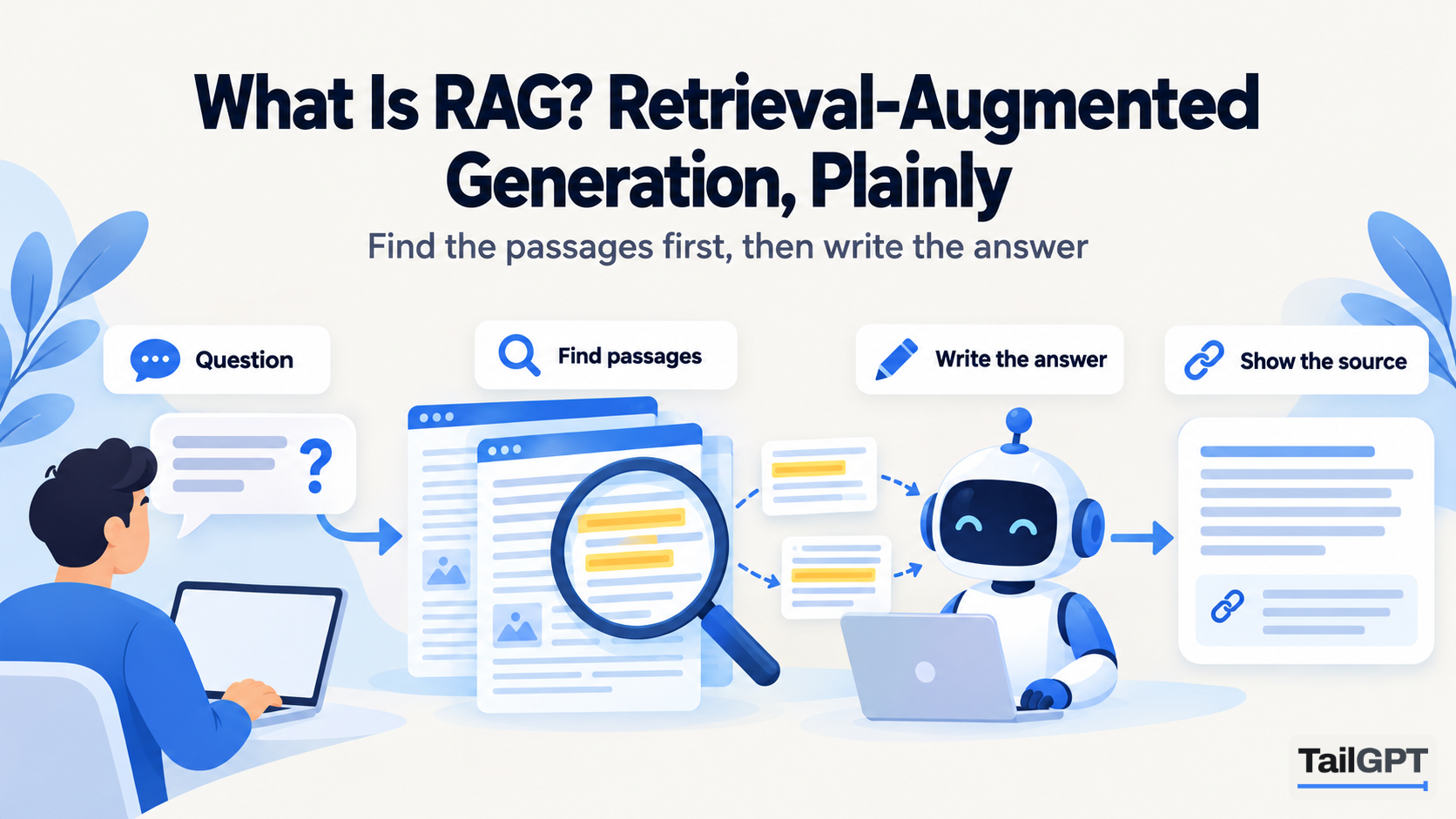
RAG stands for retrieval-augmented generation: find the relevant text first, then write the answer from it. Each word does one job.
- Retrieval means finding. Before answering, the system looks through a collection of text for the passages that match the question.
- Augmented means added to. Those passages are handed to the language model alongside the question.
- Generation means writing. The model writes a reply, in sentences, using what it was handed.
The name comes from a 2020 research paper by Patrick Lewis and colleagues, "Retrieval-Augmented Generation for Knowledge-Intensive NLP Tasks", presented at NeurIPS that year. Their model looked passages up in Wikipedia before writing. The paper noted two problems with a model that answers from memory alone: it is hard to update what it knows, and hard to say where an answer came from. Looking things up at the moment of the question goes at both.
How does RAG work, step by step?
RAG works in three steps: the text is prepared once, then every question is matched to passages and answered from them. Take a visitor on the cake shop's website who types "Do you deliver to Hinjewadi, and what does it cost?"
- Prepare. Ahead of time, the shop's pages are read and split into passages, so that a long page about delivery becomes several short pieces that can be found on their own.
- Retrieve. When the question arrives, the system searches those passages for the ones that match it by meaning, not only by shared words. "Hinjewadi" and "what does it cost" lead it to the passage on the delivery page that lists areas and charges.
- Generate. The model is given the question and that passage, and writes a short reply: yes, Hinjewadi is covered, and here is the charge the page states.
The difference from a general chatbot is the second step. A general assistant goes straight from question to answer, writing from whatever it absorbed during training. It has never seen the cake shop's delivery page, so it can only produce something that sounds like a delivery policy.
| A general chatbot | A chatbot using RAG on your site | |
|---|---|---|
| Where the answer comes from | What the model absorbed in training | Passages found on your pages for this question |
| Knows your delivery charge | No, it can only guess | Yes, if a page says it |
| After you change a price | Still answers from training | Answers from the new page once it is read again |
| When nothing matches | Writes something plausible anyway | Depends on its rules, which is the next question |
Why does RAG matter for a chatbot on your website?
RAG matters because it is what lets a chatbot answer from your pages rather than from general knowledge. A visitor asking the cake shop about eggless options does not want an average of every bakery on the internet. They want this shop's answer, and the only place that answer exists is this shop's website.
It also changes how you keep the chatbot right. With RAG, the knowledge lives in your pages, not inside the model. When the shop raises its delivery charge, it edits the delivery page and has the site read again. Nothing about the model has to change, because the model was never the place the delivery charge was kept.
What does RAG not fix by itself?
RAG does not, on its own, stop a chatbot from giving a wrong answer. It gives the model the right material to work from, and four things can still go wrong.
- The page is wrong. If the delivery page still lists last year's charge, RAG retrieves it faithfully and the chatbot repeats it. The answer is only as current as the page.
- The page is missing. If the shop has never written anything about eggless cakes, there is nothing to retrieve. What happens next depends entirely on the rules around the model.
- The wrong passage is found. A search can pick a passage that shares words with the question but answers something else, such as the delivery terms for bulk corporate orders instead of home delivery.
- The model ignores or adds to its passages. Being handed the right text does not force a model to stick to it. It can blend in what it absorbed in training, or fill a gap with something that sounds right. NIST's Generative AI Profile counts output that diverges from the input a model was given as part of the same failure it calls confabulation.
The last two are why the rules around RAG matter as much as the retrieval. A chatbot needs to be told to answer only from the passages it was given, and to say so plainly when they do not cover the question rather than guessing. Without those rules, RAG is a better starting point for the same old problem. The existing post on why AI chatbots make things up covers how to test for this before customers see it, and the companion post What Is an AI Hallucination? explains what the guessing is and why it happens.
How does TailGPT use RAG?
TailGPT uses RAG with one website at a time: it reads the pages you choose and the documents you upload, finds the passages that match each question, and answers only from them. In plain terms, for the cake shop it works like this.
- It reads what you pick. When you add your website, TailGPT lists its pages and you tick the ones it should read. It opens each one in a real browser, keeps the content and drops menus, footers and cookie banners. You can also upload PDF, Word and text files, such as a price list that is not on the site.
- It finds the matching passages. Each question is matched against what was read from your pages and documents, and nothing else.
- It answers only from them. No general knowledge. The chatbot's role (Support, Sales, FAQ or your own instructions) changes the manner of the answer, never what it is allowed to say.
- It says when nothing matches. If nothing on your site matches the question, it does not try to answer. It tells the visitor plainly that the website does not cover it.
- It checks after writing. An answer that cites something it was not given is thrown away, and an email address or phone number that appears on none of the pages it read is removed.
A follow-up such as "and how much is that?" works because the chatbot is given the last three exchanges of that conversation, and nothing more. The chat shows the answer as plain prose. The whole journey, from adding a website to putting the chatbot on it, is on the how it works page.
How do you get better answers from a RAG chatbot?
You get better answers by giving retrieval clear text to find. A few habits help any RAG chatbot, not only TailGPT.
- Write facts in words. A delivery chart saved as an image cannot be read as text. Write the areas and charges out.
- Put the answer near the question. A passage that says "Delivery to Hinjewadi costs ₹150" is easy to find and hard to misread. One that says "standard charges apply" helps nobody.
- Choose the pages on purpose. Old campaign pages and duplicates give the search more ways to pick the wrong passage.
- Read the site again after a change. In TailGPT, re-reading is something you start from the dashboard, from a monthly allowance. It does not happen on a schedule, so a new price is used once you have asked for the read.