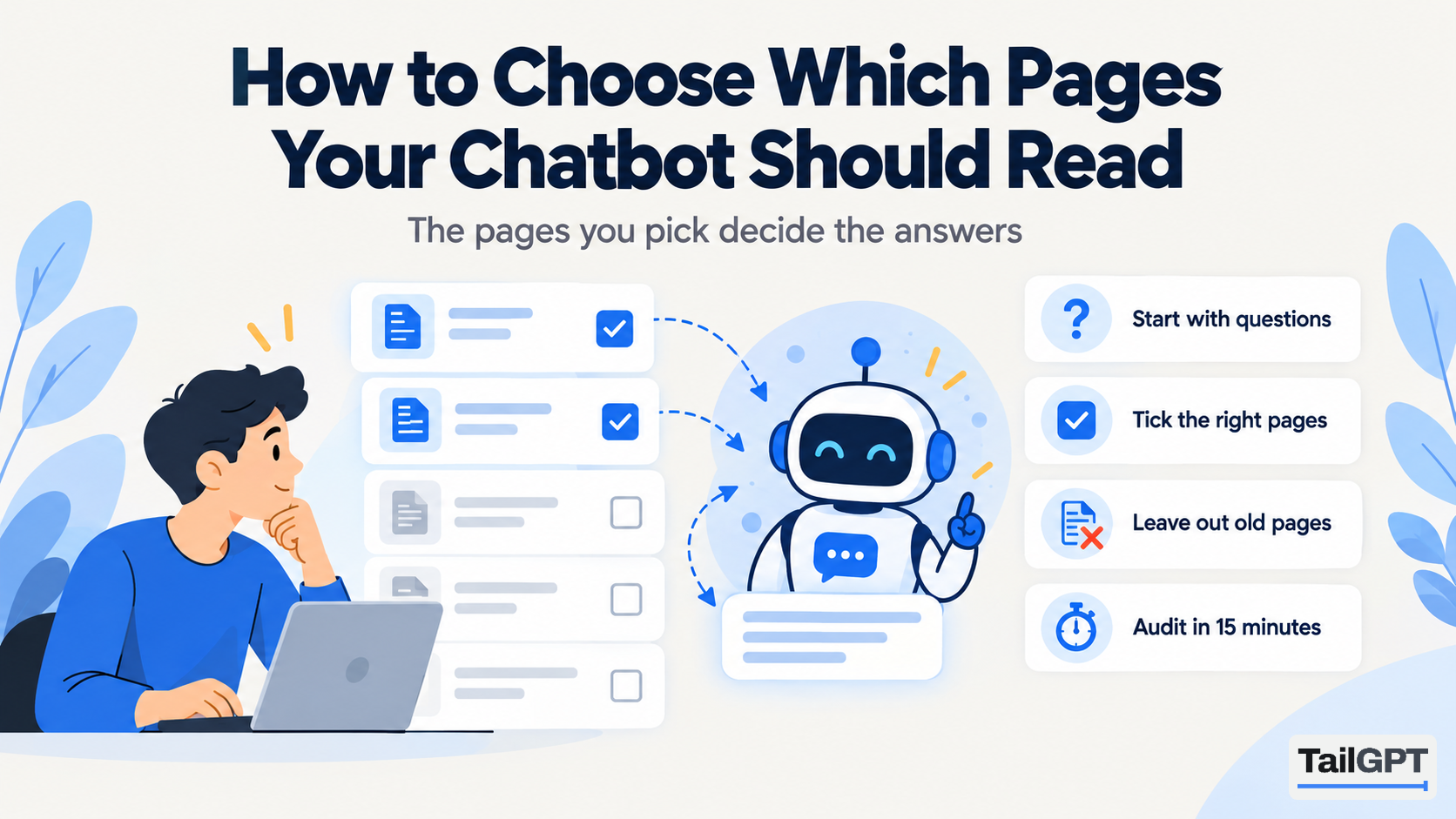
The pages you pick decide the answers you get. Choose the ones a customer would ask about, and leave out everything written for somebody else.
Start with the questions, not the sitemap
Open your support inbox and read the last fifty messages. Nearly all of them will point at the same handful of pages: delivery, returns, payment, sizing, availability, contact. Those pages go in first, and they will answer more questions than the next fifty pages combined.
Only then look at the list of pages your site has. Reading it top to bottom, ticking what looks important, is how a chatbot ends up knowing your 2019 Diwali campaign by heart and nothing about your return window.
The pages worth ticking
- Policies. Delivery, returns, refunds, warranty, payment methods.
- The products or services themselves. What they are, what they cost, what is in stock, what they do not do.
- Practical detail. Opening hours, locations, how to contact a person, how to book.
- The few how-tos customers actually need. Care instructions, installation, sizing guides.
What to leave out
- Old campaigns. A sale from three years ago is a promise you are no longer making.
- Press releases. Written for journalists, not customers.
- Category listings. Often nothing but links, which read as nothing at all.
- Anything duplicated. Two pages saying different things about returns is how a chatbot gets caught in the middle - and it will quote one of them, not both.
- Pages behind a login. They cannot be read, and they are written for one customer, not for anybody who opens the chat.
When your plan limits the pages
Most chatbots price by how many pages they read, which sounds like a restriction and is usually a discipline. A 500-page shop still has about 25 pages that matter, and they are almost always the policy and product pages. If you are at the limit, take out the oldest blog post before you take out the returns policy.
A useful test for a borderline page: has anybody ever emailed you a question this page answers? If not, it is not earning its place.
Keep it current
A chatbot knows your website as it was when it last read it. Change your returns policy and the old one keeps being quoted until you read the site again. Put "read the site again" on the same list as "update the page" - it takes a few minutes and it is the single most common cause of a wrong answer.
The same goes the other way. If you add a page because the chatbot kept failing a question, it does nothing until the site is read again.
A fifteen-minute audit
Do this before you tick a single box. List the last twenty questions customers asked, from your inbox or your phone notes. Beside each one, write the page that answers it - and if there is not one, write "none".
The pages named twice or more are your starting set; that is usually five to fifteen pages, not fifty. The "none" rows are the pages to write, in the order they appear. And any page you were about to tick that is named nowhere on the list can wait.
It takes a quarter of an hour, and it consistently beats the alternative, which is reading the sitemap and ticking whatever looks useful.