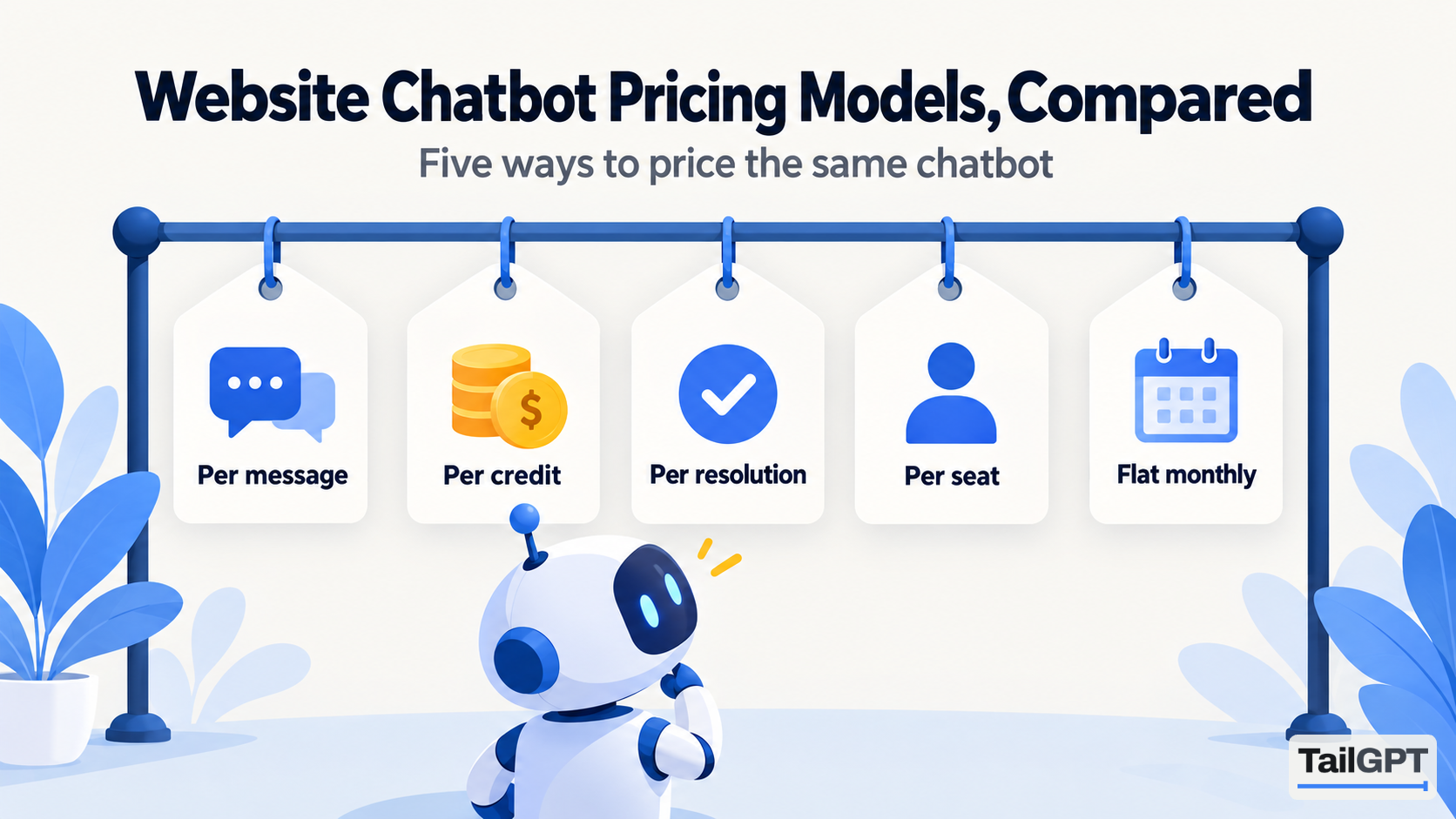
Website chatbot pricing pages are hard to compare because they are not measuring the same thing. One counts messages, one counts credits that shrink with the model you pick, one bills for each conversation it resolves, one charges per person on your team, and one charges a fixed amount for a number of questions. Put the headline prices side by side and you are comparing kilos with litres.
This post lays out the five common pricing models, what each one rewards and punishes, and a method for turning any of them into one comparable figure for your own website. TailGPT uses the last model, and its figures are as of 4 October 2026.
What are the main ways website chatbots are priced?
There are five common models, and many plans combine two of them. In outline:
| Model | You pay for | The bill rises when | Usually suits |
|---|---|---|---|
| Per message | A monthly allowance of messages, or a price per message | Conversations get longer, or both sides are counted | Sites with short, predictable chats |
| Per credit | A monthly allowance of credits that each answer spends | You choose a larger model or features that take extra steps | Buyers who want to choose models and tune cost |
| Per resolution | A fee for each conversation the bot is judged to resolve, often with seats | The bot gets better, or traffic rises | Staffed support teams already on a helpdesk |
| Per seat | A monthly fee for each person who uses the inbox, with AI as an add-on | You add people to the team | Teams answering live chat themselves |
| Flat monthly, question allowance | A fixed price for a set number of questions a month | You move to a bigger plan or buy more questions | Businesses that want a fixed budget line |
None of these is a trick. Each one puts a different risk on the buyer, and the useful question is which risk your business can carry.
How does per-message pricing work?
You buy a number of messages a month, and each message in the chat uses one. The thing to check is what a message is. Some plans count only the bot's replies; some count the visitor's messages too; some count the automatic greeting. A plan of 2,000 messages that counts both sides covers roughly 1,000 questions.
The risk is length. A visitor comparing three courses or two hotel rooms may send six messages, and the bot answers each. Sites where people ask one thing and leave spend slowly; sites where people browse through the chat spend fast.
How does per-credit pricing work?
You buy credits, and each answer spends some. Commonly an answer from a smaller model uses one credit and one from a larger model uses several, and some features use extra. At one credit an answer, 4,000 credits is 4,000 answers. At six, it is 666.
The flexibility is real: you can choose a cheaper model for simple questions and a larger one where quality matters. The risk is that the answers per month are decided by settings, not by the plan. Message credits vs questions works through the conversion in detail.
How does per-resolution pricing work?
You pay each time the bot is judged to have resolved a conversation, usually on top of seats in a helpdesk, and sometimes with a monthly minimum. Conversations it fails on cost nothing.
The model fits a support team that knows its cost per ticket. Its unusual property is that the bill rises as the bot improves: at an unchanged rate, going from 40% to 70% of 1,000 conversations resolved takes the bill from 400 resolutions to 700, with no change in visitors. Per-resolution chatbot pricing, explained covers definitions, minimums and when it is the right choice.
How does per-seat pricing work?
You pay for each person who logs in to answer chats, as with most live chat and helpdesk software. AI answering is then sold as an add-on, often metered on its own: by conversations, by resolutions or by a monthly allowance.
Seats make sense when people are answering chats, because the people are the product you are equipping. For a business where nobody is free to watch a chat window, seats pay for an inbox nobody opens. AI chatbot or live chat helps decide which you need.
How does a flat monthly plan with a question allowance work?
You pay a fixed price for a set number of questions each month, whatever the length of the answers and with no model to choose. That is how TailGPT is priced. As of 4 October 2026:
| Starter | Growth | Enterprise | |
|---|---|---|---|
| Price | ₹4,000 a month | ₹8,000 a month | Custom |
| Questions a month | 4,000 | 10,000 | Up to 5,00,000 |
| Websites live at once | 1 | 3 | Up to 1,000 |
| Pages read, shared across websites | 1,000 | 7,500 | Up to 1,00,000 |
| Chatbots | 1 | 3 | Up to 10,000 |
| Website re-reads a month | 2 | 8 | Up to 2,000 |
Each question a visitor asks counts as one, including follow-ups and questions your pages do not cover. Attempts to give the bot orders, requests to write code and too many questions too fast are refused with one fixed sentence and do not count. Questions are one pool for the whole account. Billing is monthly, by card.
The risk sits in a different place: at the limit. You get an email at 80% and at 100% of the month's questions, and then the chat bubble goes quiet until the month resets, you upgrade, or you buy a top-up. There is no overage bill, but there are no answers either until you act. Top-ups add questions only, never expire, and are used after the month's plan allowance.
How do you compare plans across different models?
Turn every plan into one figure: what your busiest month would cost, for the job you actually need done. Five steps:
- Estimate your traffic. Monthly visits, share who open the chat, questions each, and the number of conversations. Do it for an ordinary month and your busiest. How many chatbot questions a month has the method and examples.
- Convert each plan's unit. Messages ÷ messages per question. Credits ÷ credits per answer on the model you will use. Resolutions = conversations × a low and a high resolution share. Seats = people who will log in.
- Add the other lines. Seats, minimums, add-ons, extra websites, extra pages, and anything sold separately, such as removing the vendor's branding.
- Read what happens at the limit. The bot stops, you pay overage, or you are moved up a plan. Each is fine if you know which.
- Check it does the job. A cheaper plan that cannot do what you need is not cheaper.
An illustrative shop expecting 3,000 questions in an ordinary month and 6,000 in its sale month would check: does a message plan count both sides (then it needs about 6,000 messages in an ordinary month); how many credits an answer uses on the model it wants; and, on TailGPT, whether Starter's 4,000 covers the ordinary month (it does) and how to handle the sale month (Growth for that month, or a top-up).
What does a pricing table leave out?
The things that decide whether the tool fits, which no unit price captures. Before choosing on price, check:
- Where it answers. TailGPT works only as a widget on your website. It does not answer in WhatsApp, other messaging apps, email or on the phone, and it has no API or integrations.
- What it can do besides answer. TailGPT cannot capture leads, take bookings, look up orders or hand a chat to a person. Tools that do those things are pricing more than answers.
- What it answers from. TailGPT answers only from your selected pages and uploaded PDF, Word and text files, never from general knowledge, and says plainly when they do not cover a question.
- How it stays current. TailGPT re-reads your website when you ask, from the monthly allowance in the table. There is no automatic refresh.
- Branding. Every TailGPT chat window ends with a small "Powered by TailGPT" line, and it cannot be removed on any plan.
- Trying it. TailGPT's free trial reads up to 500 of your pages and gives you 20 test questions, with no card. Putting the chatbot on your site needs a plan.
Which pricing model should a small business choose?
Choose the model whose risk you can carry, then the cheapest plan in it that does the job. As a rough guide:
- A staffed support team on a helpdesk that needs actions on orders and several channels: per-resolution or per-seat pricing, measured against your cost per ticket.
- A team that answers live chat and wants AI help alongside: per-seat with an AI add-on.
- A buyer who wants to tune models and cost and will watch usage: per-credit.
- A business that wants a fixed monthly line for answering visitors' questions from its own website: a flat plan with a question allowance, such as TailGPT.
AI chatbot pricing: what you are actually paying for explains the other limits on a plan, such as pages and websites, and TailGPT's pricing page lists every one.