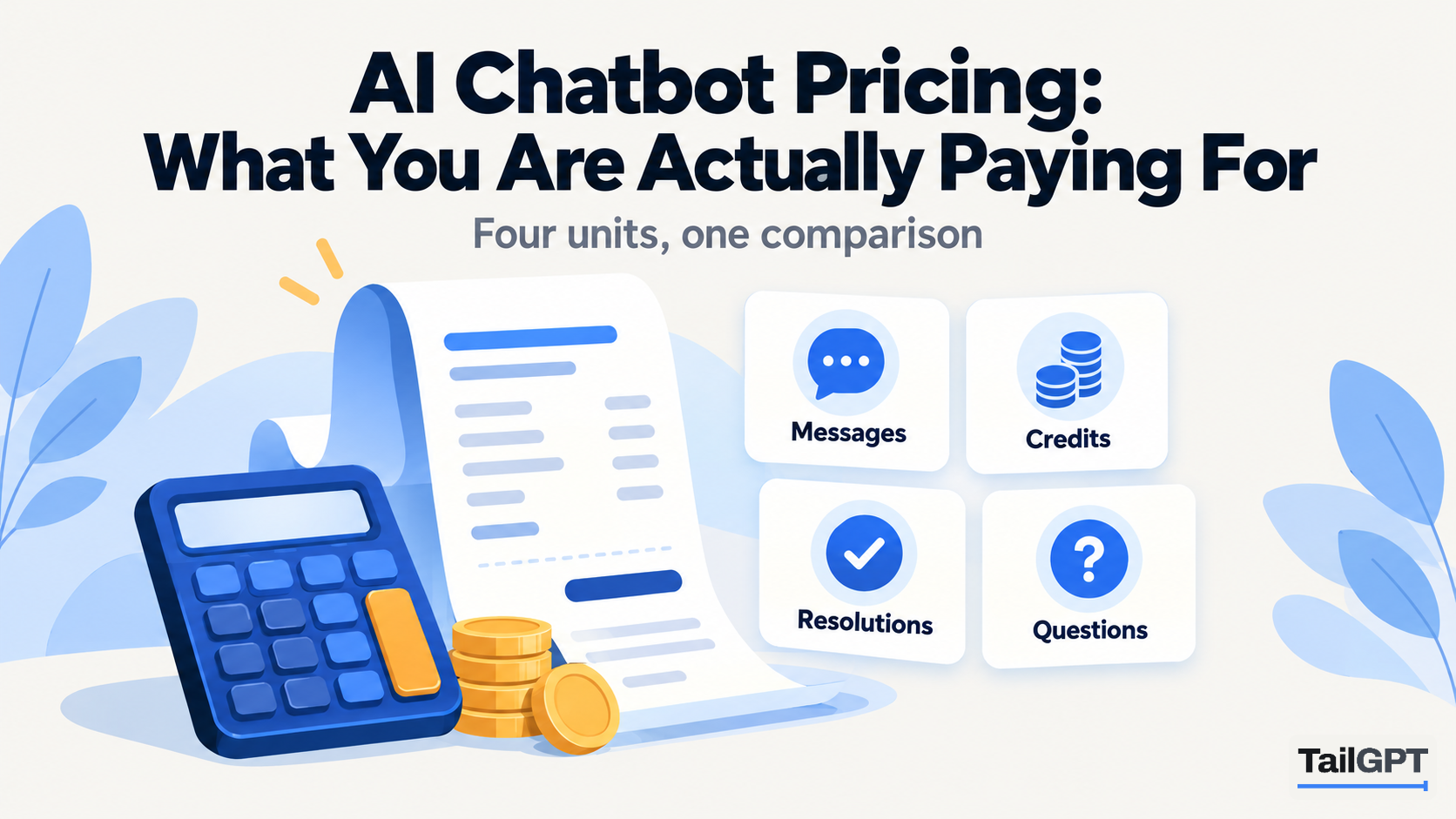
Chatbot prices are quoted in four different units, which is what makes them hard to compare. Learn the units and the comparison takes five minutes.
The four units
- Pages read. How much of your website it knows. The most predictable, because your website does not double overnight.
- Conversations or questions a month. Tracks your traffic, which is the number that surprises people after a good campaign.
- Seats. Made for live chat teams. A poor fit when nobody is sitting at it, and a reason some tools look expensive for what you use.
- Messages or credits. Hardest to predict, because one talkative visitor can spend a lot of them in a minute.
The questions that decide the bill
- What happens at the limit - does it stop answering, queue, or charge you more?
- Are re-reads of your website counted against the page limit?
- Does a second chatbot on the same site cost the same as the first?
- Are documents counted as pages?
- Is the price per month with a yearly commitment, or genuinely per month?
Work out your own number
Take your monthly visitors. Assume a small fraction open the chat - a few per cent is normal on a shop, more on a site with complicated products - and assume two or three questions each. That gives you a monthly question count, and it is the number to compare against plan limits, not the headline price.
Do it twice: once for today, and once for the best month you can imagine. A plan that fails in your best month is a plan that fails exactly when it matters.
What is worth paying for
Once you can compare like with like, most of the price difference turns out to be about things that have nothing to do with answering questions: a dashboard full of charts, integrations you will not connect, a seat for a team you do not have.
The things worth paying for are duller. Enough pages to cover your real website. Enough questions to survive your busiest month. Answers that cite their source, and a record of the ones it could not answer.
Three traps in the small print
- The monthly price that is not monthly. Many plans show the yearly-commitment price with a smaller monthly figure beside it. Compare like with like.
- Overage that is silent. Find out whether passing the limit stops the bubble, queues visitors, or bills you. All three happen, and only one of them is a surprise on an invoice.
- The second chatbot. Support and sales on one site is a common arrangement. On some plans the second one is free; on others it is a second subscription.
None of these is dishonest, and all three are easy to miss when a comparison table shows one number per tool.