A question allowance is the number that decides which plan you need, and it is the one number nobody can tell you before the chatbot is live. You can still estimate it well enough to choose between 4,000 and 10,000 questions a month, and then read the real figure after a few weeks. AI chatbot pricing: what you are actually paying for explains why questions are the unit to watch. This post does the arithmetic.
How do you estimate how many questions your site will get?
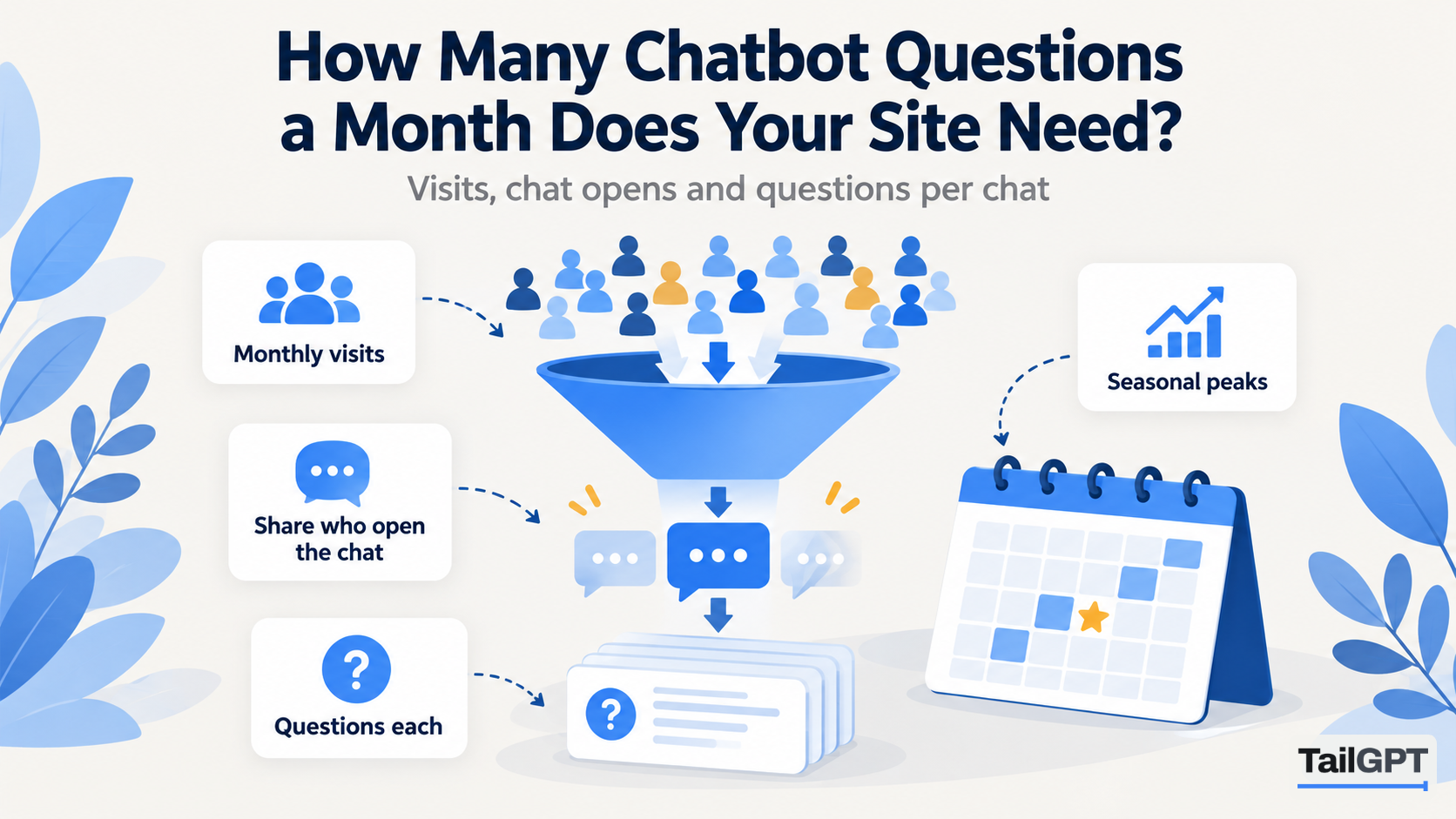
Multiply three numbers: monthly visits, the share of visitors who open the chat, and the questions each of them asks.
Questions a month = monthly visits × share who open the chat × questions each
- Monthly visits. Take it from your analytics, for an ordinary month and for the busiest month of the last year. Use visits rather than unique visitors: somebody who comes back three times can ask three times.
- Share who open the chat. A guess until the bot is live. A few per cent is a fair starting point for a shop. It is higher where the answer visitors want is hard to find on the page (fees, eligibility, timings, delivery to a particular pin code) and lower on a site people read quickly and leave.
- Questions each. Usually between one and four. A follow-up like "and how much is that?" is a question too, so a visitor comparing two courses or two rooms asks more than one checking your opening hours.
The result is rough, and that is fine. Plans are far enough apart that you only need to know which side of 4,000 or 10,000 you are on, in an ordinary month and in your busiest one.
What does the estimate look like for five kinds of business?
It ranges from a few hundred questions a month to several thousand, depending far more on the kind of business than on its size. The figures below are illustrative assumptions chosen to show the method, not data from real customers. Replace each one with your own.
| Business | Visits a month | Share who open the chat | Questions each | Questions a month | Plan that covers it |
|---|---|---|---|---|---|
| D2C clothing shop, Jaipur (ordinary month) | 40,000 | 3% | 2.5 | 3,000 | Starter (4,000) |
| Same shop, festive sale month | 80,000 | 4% | 2.5 | 8,000 | Growth (10,000) |
| Dental clinic, Pune | 6,000 | 5% | 2 | 600 | Starter |
| Coaching institute, Kota (ordinary month) | 15,000 | 4% | 3 | 1,800 | Starter |
| Same institute, admission season | 60,000 | 5% | 3 | 9,000 | Growth |
| Boutique hotel, Goa (ordinary month) | 12,000 | 6% | 3 | 2,160 | Starter |
| Same hotel, December | 25,000 | 6% | 3 | 4,500 | Starter plus a top-up, or Growth |
| B2B IT services firm, Bengaluru or London | 8,000 | 1.5% | 3 | 360 | Starter |
The D2C shop
Shoppers ask about sizes, fabric, delivery times and returns, often two or three in a row. In an ordinary month the shop sits comfortably inside Starter. In the festive sale month traffic doubles and more people open the chat, because offers raise questions, and the estimate runs to twice Starter's 4,000.
The clinic
Patients want timings, the address, whether a treatment is offered and roughly what it costs. Many visits, few questions each, and a total well under Starter. For a clinic, the limits that matter are more likely to be pages read and what the bot should not say than questions.
The coaching institute
Ordinary months are quiet. Admission season is not: parents and students ask about fees, batches, eligibility, scholarships and the test date, and each of them asks several. One season can be five times an ordinary month, which is the case for planning around the peak rather than the average.
The hotel
Guests ask about check-in times, parking, breakfast, pets and distance to the beach. The ordinary month fits Starter; December runs about 500 questions past it. That is the shape a top-up is made for.
The B2B services firm
Few visitors open the chat, and those who do ask a few careful questions about services, industries and how an engagement starts. A few hundred questions a month is typical of the assumption. Questions will not be this firm's limit; if it runs two websites, the number of websites live at once will be.
How do seasonal peaks change the plan you need?
Size for your busiest month, then decide whether to pay for that peak all year or handle it when it arrives. There are three ways to handle it with TailGPT.
- Growth all year. Simplest when peaks are frequent or close to Growth's 10,000.
- Starter, upgraded for the peak. Upgrading takes effect at once, so you can move to Growth when the season starts. Moving back down later deletes nothing: extra websites are switched off and kept, not removed.
- Starter plus a top-up. A top-up adds questions only. It never expires, is used only after the month's plan allowance runs out, is drawn oldest pack first, needs a live plan and is not refundable. Bought before a season you expect, unused questions wait for the next one.
Remember that questions are one pool for the whole account. On Growth with three websites, add the three estimates together: every chatbot on every website draws from the same 10,000. Preparing a chatbot for a sale or launch covers the rest of getting ready for a rush.
What does TailGPT count as a question?
TailGPT counts every question a visitor asks a chatbot on your website, including follow-ups, with three exceptions that cost nothing. Attempts to give the bot orders ("ignore your instructions…"), requests to write code, and too many questions too fast are all refused with the same sentence, "I can only answer questions about this website", and none of them uses one of the month's questions.
A question your pages do not cover does count. The bot looked through your pages before it could say plainly that your website doesn't cover it, and that answer is honest rather than free. The useful response is to write the missing page: the dashboard lists the questions your pages could not answer, with how often each was asked, and what to do when your chatbot says it does not know walks through turning those misses into pages. Visitors never see anything about your allowance or billing.
What happens when you reach the monthly limit?
The chat bubble goes quiet: it disappears from your site until the month resets, you upgrade, or you buy a top-up. Two emails come first, one at 80% of the month's questions and one at 100%.
The 80% email is the one to act on. On Starter it arrives at 3,200 questions. If that happens in the third week of the month, you are on course to run out, and you have time to buy a top-up or upgrade before the bubble disappears. If it arrives on the 29th, you can probably let the month roll over.
A quiet bubble shows visitors no error and no billing message. They see your website as it was before the chatbot, which is a better failure than a broken widget, but it is still a month of questions going unanswered, usually in your busiest weeks.
How do you find your real number once the chatbot is live?
Read it from Show chats after a month, then replace each guess in the estimate with a real figure. Show chats lists every conversation a chatbot has had, and its figures (conversations, questions, messages, average and longest length) follow the filters you set.
- Filter each chatbot to the last 30 days and note its questions. Add the chatbots together, because they share one pool.
- Divide questions by conversations. That is your real "questions each".
- Divide conversations by the same month's visits from your analytics. That is your real share who open the chat.
- Put both ratios into your busiest month's traffic. That is your peak estimate, now based on your own visitors.
After three months, the 90-day filter shows whether the number is steady or climbing. Show chats does not include refused questions, which is convenient here, because those do not count against the allowance either. It also keeps working after a plan lapses, so the history is there when you come back.
Should you choose Starter or Growth?
Choose Starter if your ordinary month stays below about 3,200 questions and your busiest month stays below 4,000, and Growth if your ordinary month sits between 4,000 and 8,000 or you need more than one website. As of 4 October 2026, Starter is ₹4,000 a month for 4,000 questions and Growth is ₹8,000 a month for 10,000.
- Starter: the clinic, the B2B firm, the hotel outside December and the institute outside admissions.
- Starter with an upgrade or a top-up for the peak: the hotel in December, the shop in its sale month.
- Growth: the institute if admission season covers several months, any business with two or three websites, and any site whose ordinary month is already past 4,000.
- Beyond 10,000 a month: Growth with top-ups for occasional months, or Enterprise, which goes up to 5,00,000 questions a month at a custom price.
Questions are not the only limit. Starter reads 1,000 pages on one website with one chatbot; Growth reads 7,500 pages across three websites with three chatbots. A small question count on a large site can still need Growth. The pricing page has every limit side by side, and website chatbot pricing models, compared shows how the same question count works out when a plan counts messages, credits or resolutions instead.