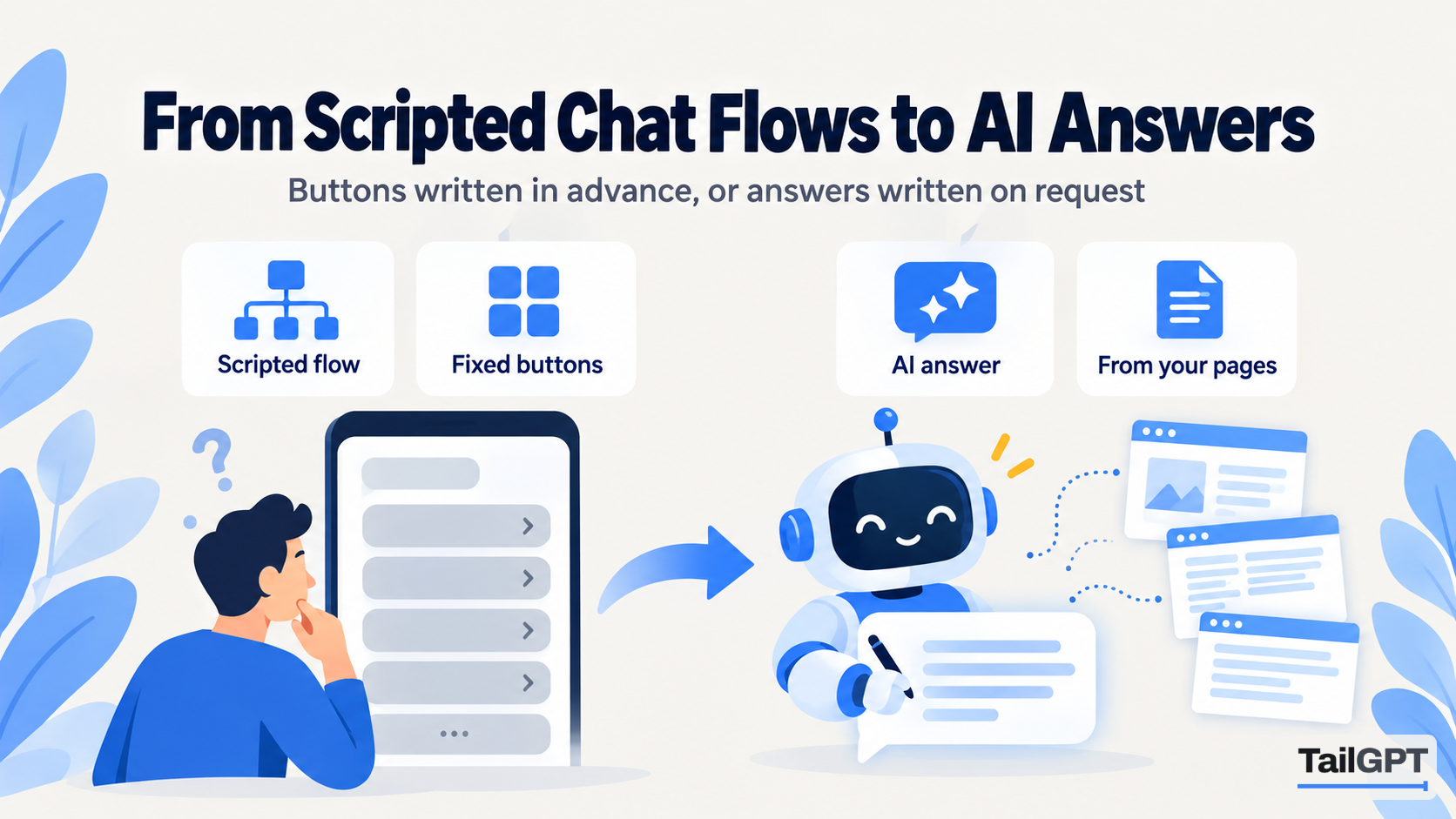
For years, a chatbot on a small business website meant a chat flow: a greeting, three or four buttons, and a tree of scripted replies behind them. Somebody drew the tree, wrote every reply, and updated it when the business changed. Many sites still run one. The newer kind of website chatbot has no tree at all. It reads your pages and answers whatever the visitor types, in its own words, from what those pages say.
This post explains the difference in plain terms, what each kind is good at, and what changes if you move from one to the other. The examples of the second kind are TailGPT's.
What is a scripted chat flow?
A scripted chat flow is a decision tree written in advance. Every message the bot can send was typed by a person, and every path through the conversation was planned. The visitor moves through it by tapping buttons or, in some builders, by typing a word the flow is listening for.
A typical flow for a dental clinic might look like this:
- Greeting: "Hi, how can we help?" with buttons for Timings, Treatments, Book a visit and Something else.
- Treatments opens a second row: Cleaning, Braces, Root canal, Implants.
- Each of those shows a short reply someone wrote, and perhaps a link.
- Something else asks for a phone number and says the clinic will call back.
Nothing in that conversation was decided on the spot. That is the flow's great strength and its main weakness.
How is an AI answer different?
An AI answer is written at the moment the visitor asks, from material the bot has read. There are no buttons to design and no replies to write in advance. The visitor types "do you do braces for adults and roughly what does it cost?" and the bot looks through the pages it was given, finds the ones about braces and fees, and writes an answer from them.
The idea behind it is called retrieval-augmented generation: find the relevant passages first, then write the answer from those passages rather than from general knowledge. What is RAG? explains it in more depth. In TailGPT's case the material is the pages of your website you choose and any PDF, Word or text files you upload, and nothing else.
| Scripted chat flow | AI answers from your pages | |
|---|---|---|
| Who writes the reply | A person, in advance | The bot, at the moment of asking, from your pages |
| What the visitor does | Taps buttons or types trigger words | Types any question in their own words |
| Questions it can handle | Only the ones someone planned for | Any question your pages cover |
| What you maintain | The tree and every reply in it | Your website and documents |
| Same wording every time | Yes | No; the facts come from the same pages, the sentences vary |
| Collecting details, booking, forms | Often built in | Depends on the tool; TailGPT does none of these |
Where do scripted flows fall short?
At the edges of the tree, which is where most real questions are. A visitor rarely has the question the buttons offer. They have a version of it with a detail attached: braces, but for a 40-year-old; delivery, but to a pin code in Assam; the weekend batch, but only if it starts before June. A flow either has a branch for that detail or sends the visitor to Something else.
Three other problems show up over time:
- The flow and the website drift apart. Fees change on the website and nobody remembers the reply buried three levels down the tree. The bot now gives a different price from the page.
- Typing breaks it. Visitors ignore buttons and type. A flow listening for the word "price" may not recognise "how much" or "fees kitna hai".
- Every new question is a design job. Adding one branch means writing the reply, placing it in the tree and testing the paths around it.
Where do scripted flows still make sense?
Wherever the bot has to do something rather than answer something. A flow is a good way to walk somebody through a fixed task with a fixed set of steps: choose a date, enter a name and number, confirm a booking, pick a reason for a return. Every step is predictable, and predictability is the point.
TailGPT does not do any of that. It cannot take a booking, look up an order, collect a visitor's email or fill in a form, and it does not hand a conversation to a person. If capturing details is the main job you want the chat window to do, a flow builder or a form on your website is the better tool for that job. What an AI chatbot for your website can and cannot do sets out the line in more detail.
The two are not mutually exclusive. Plenty of businesses keep a booking form on the website and let an answer bot handle the questions that come before somebody is ready to book.
Can an AI answer be trusted the way a scripted reply can?
It can be trusted to the extent that it is kept to your material, which is what the design has to get right. A scripted reply is safe because a person wrote it. An AI answer is only as safe as the rules around it, so ask any tool what it does in these three situations. TailGPT's answers:
- When your pages do not cover the question. TailGPT answers only from your selected pages and uploaded documents, never from general knowledge. When they do not cover a question, it says plainly that the website does not cover it, in its own words, instead of guessing.
- When an answer refers to something it did not read. If an answer cites something that was not among the pages it read, the answer is thrown away. An email address or phone number that appears in none of those pages is removed.
- When somebody tries to give it orders. "Ignore your instructions", requests to write code, and too many questions too fast all get one fixed sentence: "I can only answer questions about this website. Try asking about something on it." Text on a page that tries to instruct the bot is treated as something to read about, not to obey.
Wording is the trade-off. A flow says exactly the same sentence every time. An AI answer states the same facts from the same pages in slightly different words. If a sentence must be word for word, such as a legal disclaimer, put it on the page and keep it short. Why AI chatbots make things up covers the rest of this.
What happens to your old flow's content when you move?
It becomes website copy, which is usually where it should have been all along. The replies in a chat flow are answers to real customer questions, and most of them are better as a paragraph on the relevant page than hidden in a tree. Move them like this:
- Export or copy out every reply in the flow. Sort them by topic: timings, fees, delivery, treatments, policies.
- Check each against the website. Where the website already says it, delete the flow's copy. Where the two disagree, decide which is right and fix the page.
- Put the rest on the website. A short FAQ section on the page each answer belongs to works better than one long FAQ page.
- Upload what does not belong on a page. A detailed price list, a care guide or terms that live in a PDF can be uploaded as a document instead.
- Read the site and test. Ask the questions your flow's buttons used to offer, typed the way a visitor would, using Try demo.
Keep the flow's button labels as a test list. They are the questions somebody once decided were the most common, and the new bot should answer every one of them.
What changes in the weekly work?
You stop maintaining a tree and start maintaining your pages. That sounds like a small change, but it moves the work to the place customers see anyway. A fee updated on the website is updated for the chatbot the next time TailGPT reads the site, which happens when you ask, from a monthly allowance (2 re-reads a month on Starter, 8 on Growth, as of 4 October 2026). There is no automatic refresh, so the re-read is part of making the change.
The feedback is different too. A flow tells you which buttons were tapped. An answer bot tells you what visitors actually typed. TailGPT's Home dashboard lists the questions your chatbot could not answer with how many times each was asked, and Show chats lets you read every conversation and search any word in them. That list is a better guide to the next page you should write than any button report.
How do you decide which kind your website needs?
Look at what visitors want from the chat window, not at the technology. A rough rule:
- Mostly questions (fees, timings, delivery, what a service includes, whether something suits them): an answer bot that reads your pages.
- Mostly tasks (book, order, register, request a callback): a flow, a form or a booking tool.
- Both: a form or booking page for the task, and an answer bot for the questions that come first.
The quickest test is your own website. Try TailGPT's free trial, which reads up to 500 of your pages and gives you 20 test questions with no card, and ask it the questions your old flow's buttons were built around. How it works walks through the setup, and pricing lists every plan.